A LIFE WITHOUT MONEY
San Francisco's Golden Gate Park has long been a haven for the homeless. That its rugged topography and wooded hideaways offer a sense of wilderness within a few hundred yards of city life makes it ideal for clandestine activities, dropping a sleeping bag among them.
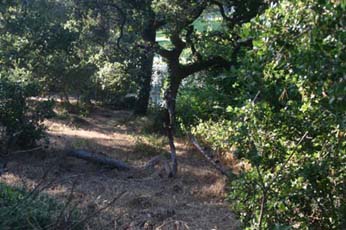 Many of the chronically homeless in the park are addicts: speed freaks, heroin users, cokeheads and those who dabble in all three. There are others who are just passing through town.
For the drifters who make their way
up and down the coast, the Haight Ashbury neighborhood, which borders the start of the park, is a midway point
and a particularly appealing stop for the transient drug dealers coming from the marijuana-rich northern counties.
There are also runaways, although most are slightly older, continuing a ritual that began when the hippies settled in the Haight in the 1960s. Those that stay break into subgroups. There are the loners, the simple potheads, a lesbian clique and even a few who still dream of going to college someday but have no idea how to go about getting there.
Many of the chronically homeless in the park are addicts: speed freaks, heroin users, cokeheads and those who dabble in all three. There are others who are just passing through town.
For the drifters who make their way
up and down the coast, the Haight Ashbury neighborhood, which borders the start of the park, is a midway point
and a particularly appealing stop for the transient drug dealers coming from the marijuana-rich northern counties.
There are also runaways, although most are slightly older, continuing a ritual that began when the hippies settled in the Haight in the 1960s. Those that stay break into subgroups. There are the loners, the simple potheads, a lesbian clique and even a few who still dream of going to college someday but have no idea how to go about getting there.
Making his way among these folk is Randall, a mostly affable 40-year old independent spirit who landed in San Francisco from Minnesota three years ago. He is not part of any of the subgroups, referring to himself as "kind of a lone wolf," but considers them his neighbors.
He is tall, lanky, good looking with a long and prematurely-white wizard-like goatee that is in conspicuous contrast to his brown hair.
Put decent footware on him and one would not guess where he sleeps at night. The groundscores
on the streets of San Francisco can provide an adequate wardrobe but finding
shoes that fit are rare.
Randall is not a drug addict, although there isn't much he would turn down if offered, his lifestyle basically granting him that freedom at any moment. He prefers marijuana and psychedelics to alcohol and, perhaps as a result, is generally coherent and competent, as good a listener as a talker. His worst habit is the occasional bout of crystal meth but,
outside of an inability to sit still and the occasional paranoia, speed freaks
generally can pass first appearances in our coffee-dominated world. In fact if
there is any mental illness in Randall, it is not any more noticeable than any
other San Franciscan. Aside from living in the park, there is only one other
thing that separates him from the rest of the loonies who have traditionally
inhabited in San Francisco.
"I totally exist on no money," he says.
He will occasionally go weeks without a dollar bill passing through his hands. He has no need to pay rent and has places to shower. For food, he knows the charity meal schedule throughout the city
and the days the churches hand out boxes. He also does his share of dumpster diving. When he needs a cup of coffee, he can usually scrounge up the change or barter, never having the need to panhandle. For recreation, he has a hacky
sack, reads at the library and has an active social network. For the past few
months, he even has had a girlfriend who works and goes to school by day and
sleeps in the park with him by night.
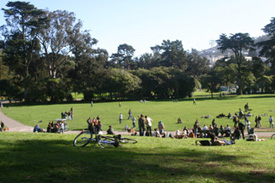 "My interest in life is a cup of coffee, maybe a good joint, some beautiful scenery. I wake up in the morning and these are the things I look for," he explains.
Money would not do him much good anyway. When he comes into it, he tends to blow
it quickly, partying like a desert cowboy who just won big in Vegas, except his
crowd is more likely to include the occasional coke whore. He will
spread the party favors around and enjoys giving money away as much as spending
it, although when it comes to himself he is apt to splurge on a $80 pair of pants or a $25 pair of underwear.
As to priorities in Randall's life, the almighty dollar is just not high on his list. The
economy of the homeless hippie world is obviously different than that of the
business world, but in that respect it at least elevates him to a more decent
form of being whatever one thinks of his lifestyle. One afternoon he scored six pairs of socks thanks to a Christian group handing them out in the park. On some days socks can be gold on the street but
Randall was just as apt to trade a pair for a lone cigarette, the concept of whether he was getting a good deal or not hardly entering the equation. He sees his world as congenial as a small town main street would be. "It's like some kind of a brotherhood," he says. "We all know each other. We all run into each other. We all stand in the same lines. We live in the same place. We're like brothers and sisters out there."
The poor, he says, are often more generous. "If I'm walking down the street - I'm a quarter short of a cup of coffee - and I see someone who looks homeless I know that if I go over and ask them, they will most likely give me a quarter, but for everyone else in the world it's up in the air whether they would help me or not."
When he comes into some spare change, he returns the favor if approached by a panhandler. "Twenty-five, 50, 80 cents is not going to help me," he points out.
Randall has had his fair share of jobs. Despite his lanky build, he is one of
those people born with near superhero strength, making him well suited
for manual labor. He has been a furniture mover, worked as a roofer, drywaller,
pipe layer and concrete mixer, and has driven "all kinds of earth-packing
big-ass machines." He also has cooked in a four-star restaurant. He works
sporadically, however, and because of that he will never make enough to move into San Francisco's overpriced housing market.
Back in Minnesota, he had a factory job painting cluster bombs for the military.
He remembers the fins, housing and "the part that explodes" all had to be a particularly color, although he cannot answer the reasoning
behind painting a bomb. He does recall being ordered not to discuss his job with
anyone because of the possibility of protests outside the plant. He also recalls
one of his supervisors, the one who programmed the robots to paint the bombs,
was the factory weed dealer.
In college, Randall was a Dean's List student majoring in computer engineering.
He had job offers but dropped out because the stress of that kind of life scared him. (He is still a computer whiz with an innovative idea for designing work stations.
But on the other hand, he also has an involved theory regarding UFOs and cattle mutilations.) A bad work experience at some point also played a role. "I decided I was not going to work for a jackass again for as long as I live. I'll go to my grave unemployed," he says. That individualism is his most defining character trait.
He also often jokes he studied French at Bismarck State. That was in addition to
learning weightlifting, it being a penitentiary. He came out of a bar one night
a little drunk and saw a pickup truck in the parking lot, door open and engine
running.
It was cold and he had a couple miles to go to get home. Perhaps, it could be
argued, because of his anarchistic view of private property, he would have
offered up his own keys in a moment of generosity had the truck been his, but it
wasn't and he didn't ask. When the cops pulled him over, Randall immediately lit
a cigarette. He knew where he was going and knew smoking wasn't allowed there. It
was not his only high-speed adventure. Previously he had led Minnesota police
across the state border into North Dakota on a motorcycle, he living in a town
right on the edge of the state.
Years later, he is still dodging the law although for far lesser offenses.
In one sense, he is living a life that would not be that unusual centuries ago. There were people like him before and after the settlers arrived in the New World. They were called woodsmen, explorers, scouts or even hermits but in modern day San Francisco his outdoor camping is illegal. At one point, he recalls having to dodge police, park rangers, DPW workers, a jailhouse work force and lesser tolerant citizens who want the park cleared.
There was one time after having moved furniture all day for $14 an hour
that he returned to where he left his belongings to find everything he owned
was gone, the police having cleared the site. Among the items not retrievable
were photos of his child, given up for adoption at birth, the parents sending
along picture albums a couple times a year. From Randall's viewpoint, the cops
are just "taking poor men's belongings from them." It is one of the reasons he will more likely return to the park to sleep,
even on cold nights, rather than take up friend's offer of housing. He doesn't like to leave his stuff alone. Hauling a backpack is the worst part of being homeless, he says, the solution being to
find a good hiding spot.
For a couple years, police had been conducting 4 a.m. raids in the park. By most accounts they were not happy about the duty, it being a policy instituted by Mayor Gavin Newsom. The talk on Hippy Hill
-- a part of the park where the homeless congregate during the day -- was that a
rich woman friend of the mayor complained she had to ride her bike past the
vagabonds every day. Whatever the origin of the policy, it was a grossly ineffective,
resulting in cops writing tickets that the homeless simply brought to an
charitable agency that dealt with them. By the time the recession was in full swing and the city's budget problems had grown worse, the raids stopped.
"Basically they would wake you up and annoy you for 15 minutes," says Randall. At that time he was living just south of the polo grounds
where several others slept, generally about a 1/4-block apart from each other. "If one saw the cops coming he would wake up the others and they would run," he said. They then would all return later after the police left.
One morning Randall recalled lying awake when he heard the cop cars going by and
stopping a short distance away. He counted six cars in all by the door slams. He
climbed a tree and watched them from a short distance until they left, praying
his belongings would not be discovered.
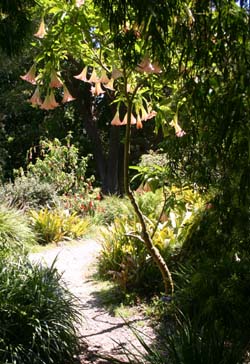 Having since moved closer to the botanical gardens, he now awakes each day smelling the flowers
in a campsite that would likely draw a pretty penny if legal. Nearby is a public restroom, which he has to share with some eccentric characters
at night. There are holes in the
stalls, presumably drilled by the same person who advertises gay sex on the
walls. That individual, Rogers describes as also homeless and pretty sketchy although presumably the gay men who wander in believing it a meeting place are likely unaware of who is on the other side.
Having since moved closer to the botanical gardens, he now awakes each day smelling the flowers
in a campsite that would likely draw a pretty penny if legal. Nearby is a public restroom, which he has to share with some eccentric characters
at night. There are holes in the
stalls, presumably drilled by the same person who advertises gay sex on the
walls. That individual, Rogers describes as also homeless and pretty sketchy although presumably the gay men who wander in believing it a meeting place are likely unaware of who is on the other side.
Two years ago on his birthday, Randall had a religious experience that changed his life.
In a dream, he saw people committing evil acts and believed he could feel God suffering.
He spoke to God and God spoke back. What startled him was that the last time he
had looked at a Bible, some 15 years earlier, he had thrown it down after reading a passage claiming to speak for how God felt about something. He did not believe anyone could know how God feels.
At first, he began reading the New Testament out of curiosity. He had an
interest in religions before. A few years prior he had studied witchcraft, casting spells on occasion. He is not sure whether they worked, sometimes it being hard to tell what was coincidence and what was not, but every once in a while something would occur that would make him stop and think. "Like I'd be hungry so I'd cast a spell for food and 99 times out of 100 I'd find food eventually. But then it occurred to me I should ask for hot food," he laughs. "And then you find a hot cooked chicken and that's when it'd get weird."
It was not long though before he began taking the Bible literally, including, he
would say the part about absolutely not working on Sundays. The interest led him deeper, going as far as to search ancient scrolls
to read as well as the Kabbalah, his inquisitiveness often driving priests to duck conversations with him.
Two years into his Christianity, he now says he is starting to understand what his dream meant. While he is still much the same person as before his conversion, it has given him a philosophy behind his views. He also has started volunteering at the same places that offered him food and shelter.
To the non believer, one might attest his spiritual vision to the occasional hallucinogenic and a closeness with nature that comes from living in the park; the result of someone who falls asleep looking up at the stars with his iPod
headphones on and watches out for UFOs every night. But
Randall denies having been on drugs at the time. He believes his spirituality comes from his lifestyle. "I see all kinds of fucked up things people do to poor people," he says,
and that he believes is what delivered him to God.
"A person who gives to the poor and feeds the poor -- a person who does these things
-- burns brighter," he explains. "That brightness keeps the demonic energies from getting close enough to you to bother you."
copyright, 2009, Wired Gypsy Publishing Network